In brief: Red light violation by LAPD detective driving city-owned vehicle causes traffic pole to strike pedestrian, resulting in traumatic brain injury
On August 22, 2020, as he’d done so many times before, Jim Simpson went out for his weekend walk in Chino, California.
He was three miles in, standing at the corner of Chino and Pipeline, when a Detective from the LAPD ran a red light. Christopher Ravenstein, a driver with the right of way, jerked his steering wheel to avoid colliding with the Detective. His Ford Expedition swerved and hit a traffic pole, which crushed down on 66-year-old Jim Simpson.
Jim’s physical wounds were visibly devastating, but his unseen injury would take years to fully reveal itself.
That’s when Garo and Armen stepped in to hold the City of Los Angeles accountable.
Total Payout
$11,800,000.00
“I was walking uphill and looking and I could see the traffic light and I was thinking okay, I'll just turn around and walk home from there. I don't remember anything at all about the accident.”
The Accident
The last thing Jim Simpson remembered was walking uphill on the dirt sidewalk toward Phillips Ranch Road. He had made this same 10-mile trek countless times over the years. That Saturday, he decided he would turn home when he reached the traffic lights at the corner of Chino and Pipeline avenues.
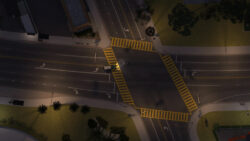
An LAPD Detective had contracted COVID two months earlier and, on that same Saturday morning, he was returning to work after a leave of absence. He drove north on Pipeline Avenue in a Honda registered to his employer, the City of Los Angeles. As he approached Pipeline’s intersection with Chino Avenue, the light was red. The Detective failed to stop.
At that moment, headed west on Chino, Christopher Ravenstein had the right of way and drove his Ford Expedition into the intersection. He barely had time to react to the Honda. He had no choice but to swerve, which caused him to then lose control of his SUV and hit the traffic light on the northwest corner. Instantly, the pole cracked away from the sidewalk and crashed down onto Jim Simpson.
When paramedics arrived, they found Jim trapped under the twisted metal. Though conscious, he was confused, repeating the same questions over and over. They suspected a mild traumatic brain injury, but of more immediate and life-threatening concern were the deep lacerations that covered his body, as well as a broken wrist, multiple pelvic fractures, and a shoulder bone that had broken through his skin. Blood poured uncontrollably from his head. They rushed Jim to Pomona Valley Hospital.
“I didn't know what I was going to see when I got to the hospital, but I was surprised to see his face and there was bones and broken things all over the place, but he was just wrapped up, his leg was hurt, his arm was hurt, and he was covered, and his head was covered.”
The Toll
Doctors immediately prescribed physiotherapy so Jim could get back on his feet and return to his life as soon as possible. Still, every time he got out of bed, he got dizzy and lost his balance. Unable to make significant physical progress, Jim was transferred to Inland Christian Home, a convalescent hospital, where he remained for another three weeks before returning to his own house, where his wife, Maria, and their youngest son, Paul, could help him.
Still, Jim was unable to sit, stand, or walk without severe physical pain. Cramps in his lower leg and foot forced him to remain immobile for a greater part of his days. He needed help with simple everyday tasks like shaving and showering, as well as eating and walking, but his family adapted their home to meet his physical needs.
Over the following months, Jim’s pain persisted, which led him to a second surgery in April 2021 to remove hardware that had come loose and was penetrating his shoulder joint. The surgeon was unable to remove the hardware without causing Jim significant disability, and instead replaced the damaged plate and cleared out scar tissue, which had built up and was causing added discomfort. After completing physiotherapy, Jim reached his maximum physical recovery by June 2022, but his cognitive issues lingered.
At the initial scene of the accident in 2020, paramedics noted Jim’s Glasgow Coma Scale was reduced to 14 (the normal is 15). His primary care doctor diagnosed TBI upon his return home, and Jim’s rehabilitation specialist confirmed both TBI and post-concussive syndrome shortly after and recommended a consultation with a neuropsychologist, as well as brain imaging, and a gradual return to work to alleviate and limit further mental fatigue.
Unfortunately, Jim’s condition wasn’t improving; it was only getting worse.
“We would go camping or backpacking at least once a month, so he was always into that kind of stuff.”
Before August 22nd
From the moment his father loaded his family onto a 46-foot trimaran to sail around the world, Jim Simpson’s life was defined by a sense of adventure and duty. He was only in the 7th grade, but this formative journey played a pivotal role in inspiring both Jim and his brother, Frank, to join the U.S. Navy.
By the time his service to his country ended, Jim had developed a passion for math and science, which he channeled into structural engineering at Cal Poly Pomona. When he graduated, he was determined to set up his own practice, which he did successfully from the ground up.
Jim’s career demanded the same dedication and reliability that made him an exemplary serviceman, and he built his business on being thorough and dependable. His projects ranged from modular school buildings to engineering the ceilings for the Purple Metro Line in Los Angeles. His clients trusted him implicitly.
Above all his professional achievements and thriving business, Jim’s greatest happiness and source of pride was his family. He had met the love of his life, Maria, in church, and together they raised three boys, Abraham, David, and Paul, each of whom followed his footsteps into military service. But tragedy struck the family in November 2004, when the eldest son, Marine Lance Corporal Abraham Simpson, was killed in the Battle for Fallujah, and Jim and Maria became Gold Star parents. The loss was unbearable, but Jim’s love for his son and commitment to his country were unshakable. He honored Abraham’s legacy by joining the California State Military Reserve.
At 66, Jim was at the pinnacle of his career, working with clients across Southern California and nationwide. Every weekend, he trekked ten miles through his Chino neighborhood, staying fit for his service in the Reserves. He and Maria planned to travel internationally once he retired, while he and his youngest son, Paul, mapped out a backpacking trip on Spain’s El Camino trail. Jim had even started thinking about returning to sailing, the passion that had taken him across the globe as a young man.
“The City of Los Angeles needs to understand the significant risks it faces in this case and compensate Jim and Maria for the significant and permanent change this incident made to their lives.”
Building the Case
Within a month after the accident and while Jim was still in convalescent care, the Simpson family approached attorneys Garo Mardirossian and Armen Akaragian. Liability appeared straightforward: The LAPD Detective clearly ran a red light in a city vehicle. However, with extensive experience in TBI cases, the lawyers recognized that Jim’s injury could present a far more complex challenge.
While Jim’s initial diagnosis did show mild TBI based on his Glasgow Coma Scale of 14, Garo and Armen knew that brain injury cases require thorough medical evaluation to even begin to understand their full impact, and that the true extent of Jim’s injuries might not reveal itself for months or even years. Rather than rush to settle based on the initial diagnosis, their strategy centered on comprehensive medical evaluation, and that strategic patience proved crucial.
“The hardest thing was that I was making mistakes that I should not have been making, and I was making them all the time.”
After August 22nd
On the recommendation of his physiatrist, Jim attempted to return to his normal life in late September 2020. He resumed work at his structural engineering firm on a limited basis, but the cognitive impact of his injuries became immediately apparent as he struggled with multitasking and problem-solving. His assistant witnessed Jim sending calculations to clients one day, only to realize the next day that he had made mistakes that required corrections, along with explanations to his clients. Unable to maintain his own high standards and the standards his clients deserved, Jim was forced to retire early.
Jim’s severe headaches, constant pain, and increasing cognitive decline also forced Jim to resign from the California State Military Reserve—a particularly profound loss, since he had joined to honor his son Abraham’s legacy after his son, a United States Marine, was killed in Iraq.
At home, Maria became his full-time caregiver. She had to install an outdoor shower and make other modifications to their home because it wasn’t equipped for Jim’s physical limitations. Maria helped him with basic activities like dressing and eating, and constantly monitored his safety.
Four years after the accident, Jim had become ambivalent, reserved, and disconnected from life. He couldn’t sleep eight hours without pain, he didn’t want to engage in activities like camping and motorcycling, which he once enjoyed, or have financial discussions and make decisions he found too complex. Once capable and adventurous, Jim now relied on his wife, and even a short walk around his neighborhood filled him with fear and panic, especially when he approached intersections.
“he most improvement comes in the first three to six months, and then anything after a year is slower to recover, and yet by now he's on the reverse recovery, where he improved for a matter of time and now he's on the reverse trajectory, where he is on decline.”
Proving the Invisible
For Garo and Armen, Jim Simpson’s case ultimately rested on two fundamental pillars: clear municipal liability and proving the existence of an invisible brain injury that would define the rest of his life.
The liability portion of the case was straightforward. Los Angeles was responsible for the Detective’s actions while driving a city-owned Honda CRV. Under California law, the Detective’s decision to run a red light violated Vehicle Code Section 21453(a) and directly caused the chain of events that led to Jim’s injuries. This aspect of the case was never in dispute.
The difficulty of the case was double-fold. Not only did Garo and Armen need to demonstrate how Jim’s condition worsened over time, but they first needed to prove that Jim Simpson had suffered a brain injury.
None of the initial brain radiology showed any brain bleeds. Without visible evidence of brain trauma on initial scans, the firm faced the challenge of building a comprehensive medical case through neurological testing and expert testimony.
Unlike broken bones or visible wounds, traumatic brain injuries require extensive medical evaluation to demonstrate their existence and impact. Garo and Armen had to prove through multiple neurological assessments that Jim’s cognitive and behavioral changes were directly linked to the traffic pole impact, not coincidental developments.
Over the first two years, Garo and Armen methodically documented Jim’s declining condition through comprehensive neurological evaluations. The breakthrough came in September 2022 when advanced diffusion tensor magnetic resonance brain imaging (DTI) revealed what standard imaging had missed: 18% of Jim’s brain showed damage, his corpus callosum had abnormal findings due to trauma, and he had lost significant function in the right frontal region.
The medical evidence established that Jim’s condition would continue to deteriorate. The firm’s comprehensive life care plan, based on this medical foundation, documented over $3.6 million in future costs for medical care alone.
“I used to get a lot of satisfaction from my work. After the accident, there wasn't any. I used to get satisfaction contributing to the California State Defense Force, but that evaporated. I used to enjoy walking all around the city, but I can't do that. I start to feel a panic when waiting for a light to change at a street corner.”
Settlement and Outcome
Faced with the medical evidence, the City of Los Angeles confronted a difficult choice. It would have to explain to a jury not only why its detective violated basic traffic laws in a city vehicle, but why the City shouldn’t compensate a decorated veteran and Gold Star father whose invisible brain injury would progressively rob him of his independence and dignity. Rather than risk a trial with these facts, the City chose to settle for $11.8 million.
Legacy and Justice
The Simpson case demonstrates the critical importance of specialized legal expertise in brain injury litigation. When initial medical scans show no obvious damage, it takes experienced attorneys to recognize the signs of invisible trauma and build a comprehensive case over time.
Jim Simpson’s $11.8 million settlement sends a clear message that governmental agencies must be held accountable when their employees’ negligence causes catastrophic harm.
Our Commitment to You
If you or a loved one has suffered a brain injury due to someone else’s negligence, early legal intervention is crucial. These cases require specialized medical knowledge and strategic patience that comes from extensive experience with traumatic brain injury litigation.
We are passionate about the people we represent, and everything we do, we do in service of bringing justice to those who have been traumatically affected due to the lack of care by others. If you or a loved one has been seriously injured due to someone else’s negligence, don’t wait to seek the legal representation you deserve.
Contact Mardirossian Akaragian LLP Today
Our firm offers exceptional talent, abundant resources, tireless dedication, and years of experience to give you the best chance of success in obtaining maximum compensation. Led by our award-winning attorneys, Garo Mardirossian and Armen Akaragian, we commit to applying our experience to pursue a favorable outcome for you, recognizing that results depend on the unique circumstances of each case.
Talk to a Los Angeles personal injury lawyer about your case or contact our firm to schedule a no-cost consultation.
Schedule Your Free Case Evaluation
ARTICLE BY
ARMEN AKARAGIAN
Admitted to practice in 2006, Armen has arbitrated, tried, and settled several cases which have resulted in multi-million dollar verdicts and settlements.
Major Cases